The Wind-Up Bird Chronicle computer files
The Wind-Up Bird ChronicleThe Wind-Up Bird Chronicle computer files are a set of stories Cinnamon stores on a computer and selectively presents to Toru Okada. More than a manuscript or archive, they are Cinnamon’s means of approaching a family past he cannot directly know: he turns gaps in inherited history into fiction, using the stories to investigate what his grandfather might have done and what that past might mean for his own existence.
Contents and Access
Cinnamon had placed sixteen stories in the computer under the title “The Wind-Up Bird Chronicle.” Toru first encountered story number eight, which he judged long enough that all sixteen, if printed, would make a fairly thick book. The numbering suggested a chronological sequence, with each story following the previous one, but Toru recognized that this was only an assumption: the stories might be ordered differently, run backward, or offer parallel versions of a single story.
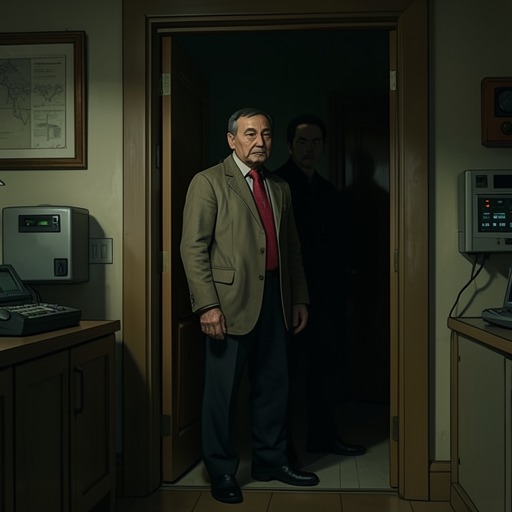
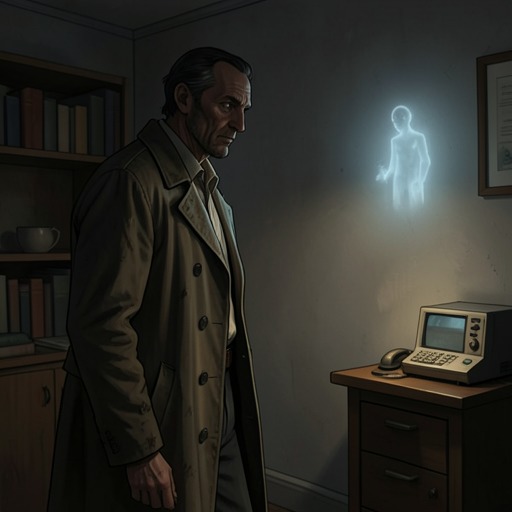
The program later presented a different scale of the collection. On the fifth night, a little after two in the morning, Toru heard sleigh bells, went from the fitting room to Cinnamon’s small office, and found a message announcing access to “The Wind-Up Bird Chronicle” and inviting him to choose a document from 1 to 17. He selected number 17. The earlier account had described sixteen stories, so the later menu complicates any simple understanding of the files as a fixed, fully enumerated collection; the evidence does not explain the discrepancy.
Story Eight and the Inherited Past
Story eight follows the story Nutmeg had told Toru about soldiers killing animals in the Hsin-ching zoo in August 1945. It takes place in the same zoo on the following day, again centering on Nutmeg’s father, Cinnamon’s grandfather, the veterinarian, whose name is not supplied. Toru cannot determine how much of this continuation is invention and how much might derive from historical events. Nutmeg had said that nothing was known about her father’s fate after their last meeting, so Cinnamon’s account cannot be treated as a straightforward record of his later life.
Toru nevertheless considers whether parts of the story might draw on historical circumstances: Manchukuo Army officer candidates could have been executed and buried at the zoo, and a Japanese officer responsible for such an operation might have been executed after the war. He also notes that desertion and rebellion among Manchukuo Army troops were not rare at the time. The detail of murdered Chinese cadets wearing baseball uniforms strikes him as unusual, but not impossible. These possibilities remain conjecture within Toru’s interpretation, not confirmation of the events depicted in the story.
Filling the Gaps
Toru reads story eight as evidence of Cinnamon’s project: a search for the meaning of his own existence through events that took place before he was born. Because he cannot reach the past directly, Cinnamon uses stories to supply its blank spaces. He takes narratives repeated by Nutmeg, reshapes them, and imagines the grandfather in a new setting. In this way, the files do not simply preserve what the family knows; they make narrative a means of exploring what remains unknown.
The distinction between fact and truth is central to that method. Toru understands that Cinnamon has inherited from Nutmeg’s stories the assumption that factual accuracy and truth need not coincide. For Cinnamon, the decisive question is therefore not only what his grandfather actually did, but what he might have done. Telling the story itself allows Cinnamon to approach an answer. The computer files turn an absence of reliable evidence into an imaginative inquiry, without resolving the historical uncertainty they expose.
Shared Motifs and Uncertain Boundaries
The phrase “wind-up bird,” which recurs in Cinnamon’s stories, did not originate with him. Nutmeg had used it unconsciously in a story she told Toru at a restaurant in Aoyama, apparently without knowing that Toru had been given the name “Mr. Wind-Up Bird.” Toru therefore sees a possible chance connection between himself and the family’s story, while allowing that Nutmeg may have known the name and that it could have entered her telling unconsciously. The story shared by mother and son may not have a single stable form: like an oral narrative, it may absorb changes and continue to grow.
Within Cinnamon’s story, the bird’s cry reaches only certain people and guides them toward ruin they cannot escape. The veterinarian appears to understand human beings as lacking control over their direction, like dolls whose springs have been wound and whose movements are set for them. Most people within range of the bird’s cry are lost or die. The chronicle’s recurring phrase thus connects the grandfather’s fatalistic view with Toru’s own name, making him part of a network of echoes without proving that the connection was deliberately planned by Nutmeg.
Cinnamon’s Deliberate Presentation
Toru suspects that Cinnamon has monitored his conversation with Kumiko through the computer. He believes Cinnamon waited until that exchange had ended before showing him a story, and concludes that the presentation was deliberate rather than a whim. Cinnamon not only ran the program for him but also gave him reason to think that a much larger body of stories existed. The files consequently function as a controlled communication: Cinnamon chooses what Toru can read while keeping the larger work partly out of reach.
That mediation shapes the reader’s access as well. The stories reach Toru through a computer whose principles and rules he does not know; after trying and failing to understand what he should do next, he shuts it down. Yet the later message reopens the archive and offers another document. The files remain both an invitation and a limit: they let Toru glimpse Cinnamon’s attempt to reconstruct the past, but their uncertain order, uncertain relation to historical fact, and selective presentation prevent him from treating that glimpse as a complete explanation.